Creation of the Universe: Christian Bible and Hindu Vedic traditions
- -
- Apr 5, 2025
- 6 min read
By Victor M Fontane
Christian Bible,Genesis 1
The Beginning
1 In the beginning God created the heavens and the earth.
2 Now the earth was formless and empty, darkness was over the surface of the deep, and the Spirit of God was hovering over the waters.
3 And God said, “Let there be light,” and there was light.
4 God saw that the light was good, and he separated the light from the darkness.
5 God called the light “day,” and the darkness he called “night.” And there was evening, and there was morning—the first day.
6 And God said, “Let there be a vault between the waters to separate water from water.”
7 So God made the vault and separated the water under the vault from the water above it. And it was so.
8 God called the vault “sky.” And there was evening, and there was morning—the second day.
9 And God said, “Let the water under the sky be gathered to one place, and let dry ground appear.” And it was so.
10 God called the dry ground “land,” and the gathered waters he called “seas.” And God saw that it was good.
11 Then God said, “Let the land produce vegetation: seed-bearing plants and trees on the land that bear fruit with seed in it, according to their various kinds.” And it was so.
12 The land produced vegetation: plants bearing seed according to their kinds and trees bearing fruit with seed in it according to their kinds. And God saw that it was good.
13 And there was evening, and there was morning—the third day.
14 And God said, “Let there be lights in the vault of the sky to separate the day from the night, and let them serve as signs to mark sacred times, and days and years,
15 and let them be lights in the vault of the sky to give light on the earth.” And it was so.
16 God made two great lights—the greater light to govern the day and the lesser light to govern the night. He also made the stars.
17 God set them in the vault of the sky to give light on the earth,
18 to govern the day and the night, and to separate light from darkness. And God saw that it was good.
19 And there was evening, and there was morning—the fourth day.
20 And God said, “Let the water teem with living creatures, and let birds fly above the earth across the vault of the sky.”
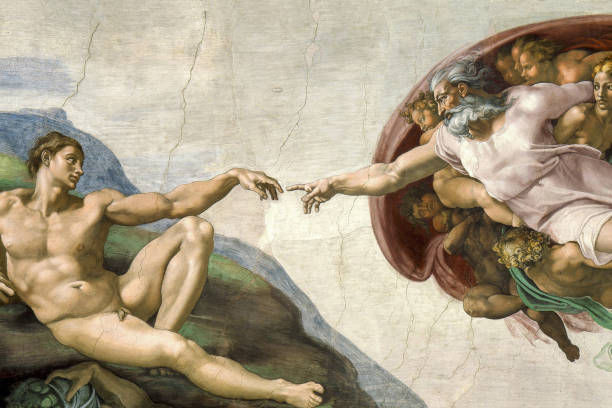
21 So God created the great creatures of the sea and every living thing with which the water teems and that moves about in it, according to their kinds, and every winged bird according to its kind. And God saw that it was good. 22 God blessed them and said, “Be fruitful and increase in number and fill the water in the seas, and let the birds increase on the earth.”
23 And there was evening, and there was morning—the fifth day.
24 And God said, “Let the land produce living creatures according to their kinds: the livestock, the creatures that move along the ground, and the wild animals, each according to its kind.” And it was so.
25 God made the wild animals according to their kinds, the livestock according to their kinds, and all the creatures that move along the ground according to their kinds. And God saw that it was good.
26 Then God said, “Let us make mankind in our image, in our likeness, so that they may rule over the fish in the sea and the birds in the sky, over the livestock and all the wild animals,[a] and over all the creatures that move along the ground.”
27 So God created mankind in his own image, in the image of God he created them; male and female he created them. Hindu Vedas Creation According to the Hindu Vedic scriptures every 311 trillion years God generates countless universes from His skinpores by His exhalation. After 311 trillion years all these universes are sucked back into the body of Maha-vishnu, when He inhales. Thus, the universe was created by Brahma, the creator who made the universe out of himself. After Brahma created the world, it is the power of Vishnu which preserves the world and human beings. As part of the cycle of birth, life and death it is Shiva who will ultimately destroy or transform the universe in a continuous process of evolution.
Man is a microcosm and the universe is the macrocosm (Brahmānda). There are innumerable worlds and universes, each of whom is governed by its own lords, although there is nothing more than a great mother of all to which the same gentlemen worship, putting on their heads the poe of her feet. In all things there is everything in anything else. There is no need to raise the eyes to heaven to find God, he is inside, being known as the "inner ruler" or interior “I am”.What is substance of physical and non physical matter in the Universe? Prakriti is "the original or natural form or condition of anything, original or primary substance". It is a key concept in Hinduism, formulated by its Sāṅkhya school, where it does not refer to matter. It is unmanifested cosmic energy or potential matter that in Sankhya philosophy is constituted of the three gunas and that in contact with purusha produces a disequilibrium among the gunas which in turn results in the production of the manifested, the phenomenal world : matter, nature. Prakriti is the ultimate "material" or the substantive cause of both the mind and of matter, and the entire u | niverse that they make up. It is the mysterious fruitful belly (Yoni) where everything is born. What she is in herself cannot be done. She is only known for her effects. Mūla Prakriti is the material cause of the phenomenal mute from which creation arises. In the last instance, it is in itself (Svarūpa), Prakriti Shakti, as everything else is consciousness. Consciousness, however, assumes Prakriti's form -that is, creative power -when the universe evolves. This form consists of the guns or ways of this natural principle (Quality, Peculiarity, Attribute, Property: Sattva, Rajas, and Tamas). The general action of Shakti is to ensure consciousness. Prakriti is a principle that forms everything apparent in infinite amorphous consciousness. This is how all the guns do, but one in greater and one on a smaller scale. The first is Sattvaguna whose function, in relation to the other guns, is to reveal consciousness. The greater the presence or power of Sattvaguna, the greater the approach to the condition of pure consciousness. Similarly, the function of Tamasguna is to suppress or ensure consciousness. The Rajasguna function is to activate or work on Tamas to suppress Sattva or on Sattvua to suppress tamas. The object and effect of evolution is to develop Sattvaguna. Gunas always coexist in everything, but they predominantly predominate. The lower the scale of nature, the more the Tamas Guna, as in the so -called "gross substance", which has been fully inert, prevails. The more it rises, the more Sattva prevails. The truly svattic human being is a divine being.Prakriti exists in two states, manifested and not manifested, one of which (respective to any effect) is quiescent (is still but able to have its own movement). The gunas then, are in stable equilibrium and do not affect each other when there is no universal manifestation. However, when, due to the maturation of the karma, the time of creation comes, there is an agitation of the gunas and an initial vibration known in the Tantras as cosmic sound. The gunas are mutually affected and the Universe is created made out of these three gunas. Thus, in infinite and formless Prakriti a tension or stress appears and the Universe appears with form.When at the end of the cycle of manifestation this tension relaxes, the forms disolves and disappear in the formless Prakriti and using its power (Shakti) re -enters Brahman's consciousness.About HumansThe Tattvas originated in the manifestation are the basis of the evolution of all cosmic matter. Tattvas and Gunas are the primordial forces that have an effect on both the physical and astral planes.
The five Tattvas are:
PRITHVĪ – EarthĀPAS – WaterTEJAS – FireVĀYU – AirĀKĀSHA – SpaceVikritis are the tattvas emanating from prakriti and the different categories of mind, senses and matter.The bodies that constitute the Humans are triple: causal, subtle and rude. These evolve from Prakriti Shakti, and are constituted by their various productions. They form the tabernacle of the spirit (ātmā), which as the Lord is "in all beings, and that from within all beings control." The Lord's body is pure sattvaguna. The ātmā appears as Jīva (Jiva ), also referred as Jivātman, is a living being or any entity imbued with a life force in Hinduism and Jainism in the various forms of plant, animal and human kingdoms. A living sentient substance akin to an individual soul.


Comments