The Japa Mala
- -
- May 3
- 8 min read
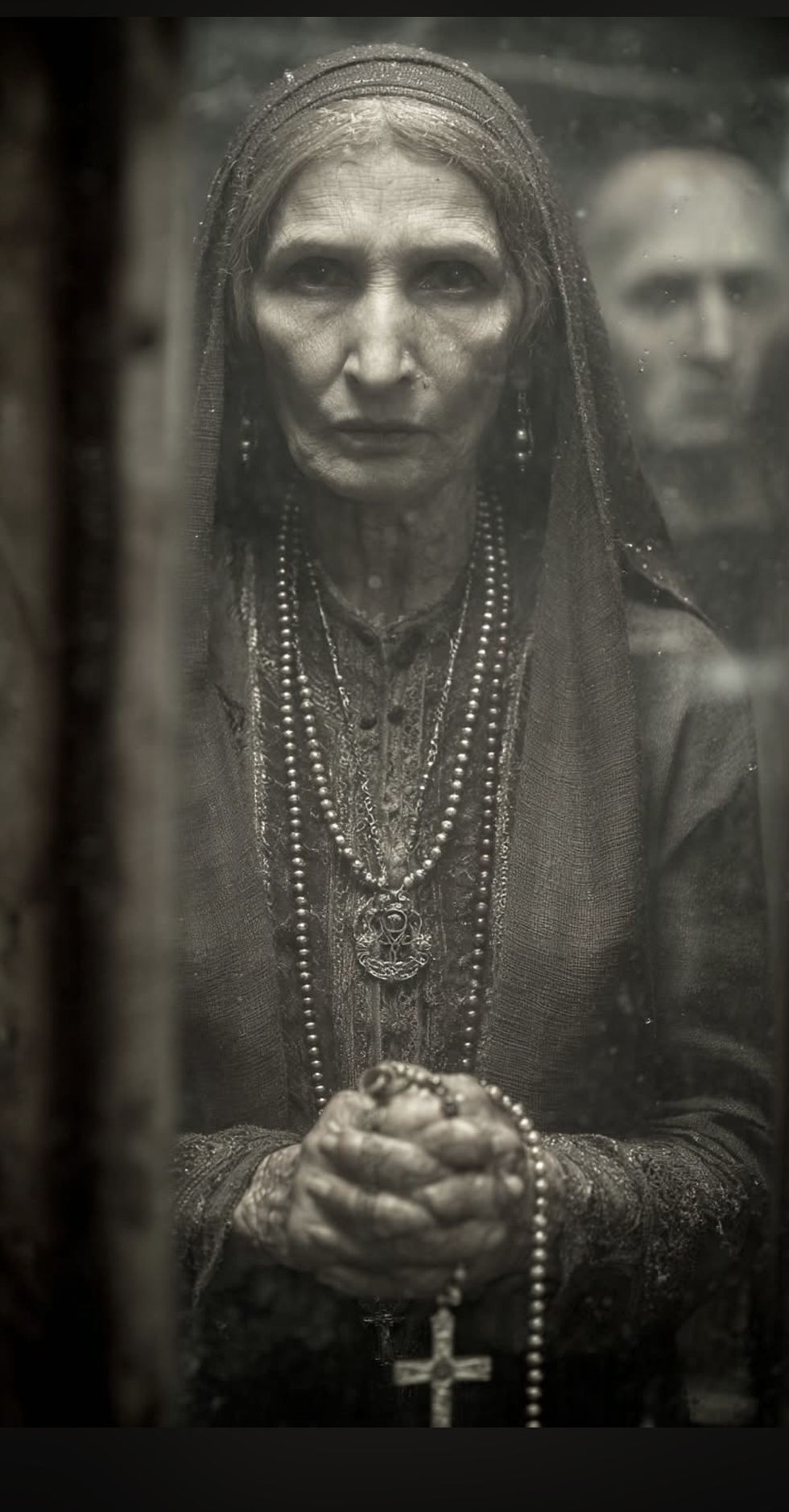
In the 13th century, tradition says that the Virgin Mary appeared to Saint Domingo de Guzmán and gave him the rosary. It's a beautiful story. The problem is that historians have found identical prayer beads in Tibetan Buddhism, Hinduism, and Islam—all before the 13th century. The question is not whether the rosary is sacred. It's where it really came from.
Before answering that question, we must pause. Because there are two ways to read what comes next.
The first is that of scandal: that the Church borrowed a pagan object and presented it as a Marian revelation. That Saint Dominic received from the Virgin what actually came from India.
The second is older and more interesting.
That when something appears in Hinduism, Buddhism, Islam and Christianity—in four traditions separated by centuries and continents—perhaps the object was not copied by any of them. Maybe it was discovered by everyone. And that discovery repeated in every corner of the human spiritual world says something about who we are, not about who had the idea first.
But to understand that you have to go to the beginning. At the true beginning. Which is not in the 13th century, it is in the 8th century BC.
In India, somewhere between 800 and 500 BC—scholars debate dates with the strained politeness that characterizes those who can't agree but also can't ignore each other—Vedic texts and early yoga practices already describe the use of seeds, stones, or beads to count repetitions of sacred mantras.
The object is called mala or japa-mala. Japa means repetition—the practice of reciting a divine name or sacred phrase thousands of times until it ceases to be a word and becomes a state. Mala means garland, or necklace. One hundred and eight beads.
The number is not arbitrary. In Vedic cosmology, 108 is a number of cosmic proportions: there are 108 Upanishads, 108 sacred names of major deities, 108 pressure points on the body according to Ayurveda. The distance between the Earth and the Sun is approximately 108 solar diameters. The distance between the Earth and the Moon is approximately equivalent to 108 lunar diameters. Whether that's coincidence or intention, no one knows for sure. But the number is there, and it has been there for two thousand eight hundred years.
The use is precise: the practitioner holds the mala in the right hand, starting with the bead next to the guru bead—the central bead, the one that is never crossed, the point of return. Each time the thumb advances one bead, the mantra is recited once. Upon arriving back at the guru bead, the direction is reversed. It never crosses. The guru bead is the center of the cosmos. You don't step on it.
That same gesture—the bead that advances, the thumb that counts, the mind that tries not to get lost along the way—is exactly the gesture of the Catholic with the rosary.
Two and a half thousand years later. On another continent. With another divine name. Buddhism took the mala from the Hindu tradition that preceded it.
Buddha was born in the 5th century BC into a cultural environment completely steeped in Vedic practices, including the use of mala. When Buddhism developed as an independent tradition, it maintained the object and the practice. He called it different things depending on the region: juzu in Japanese, mala in Tibetan and Sanskrit, nianzhū in Chinese.
One hundred and eight counts, again.
In Tibetan Buddhism—the most elaborate and visually dense form of Buddhism—the mala became an object of remarkable ritual sophistication. The beads could be made of bodhi wood – the tree under which Buddha achieved enlightenment – bone, glass, lotus seeds. Each material had specific properties for different types of practice. Each mantra had its recommended number of repetitions: some were done once, others a thousand, others ten thousand. The mala was the counting tool.
But there was more to it than the count.
Buddhist teachers insisted—and continue to insist—that the mala is not just a spiritual calculator. It's an anchor. When the mind wanders—and the mind always wanders—the physical bead in the hand calls it back. The body remembers what the mind forgets. Matter sustains what the spirit cannot sustain alone. That's what the rosary does.
In any tradition where it appears.
Islam came several centuries after Hinduism and Buddhism. And he also found the same object.
The tasbih—also called misbaha—is the Islamic rosary. It has ninety-nine beads, corresponding to the ninety-nine names of Allah. Or thirty-three beads that are crossed three times, for the same result. Its use is dhikr: the remembrance of God, the repetition of his names and attributes until that repetition transforms the one who practices it.
The word dhikr in Arabic literally means remembrance. To do dhikr is to remember God. Not as an intellectual act but as a physical, continuous act, embodied in the gesture of the fingers that advance over the beads.
The first documented mentions of tasbih in Islam appear in the 7th and 8th centuries—after the death of Muhammad, who according to some sources used date palm seeds for his dhikrs. There are hadiths that question the use of tasbih as an innovation—bidah—not explicitly practiced by the Prophet. And there are currents of Islam, especially the Wahhabi and Salafi, that reject it for that reason.
But the majority of the Islamic world uses it. And he has used it for fourteen centuries.
Ninety-nine names. Ninety-nine counts. The fingers that advance. The mind that tries to follow. The same gesture. Another divine name.
And then we come to the desert of Egypt. To the 4th century after Christ. Not to the 13th century, the 4th century.
In the monastic communities that began to form in the Egyptian desert—the Desert Fathers, the first monks of Christianity—there was a practice that no angel had taught them and that no council had decreed. It was a practice of necessity. Of spiritual physics. They prayed one hundred and fifty “Our Fathers” a day. One hundred and fifty, like the one hundred and fifty psalms. It was his way of imitating the psalmist, of fulfilling the Pauline command to pray without ceasing.
The problem was the count. There is no way to count to one hundred and fifty in the darkness of a cell, with your eyes closed, focused on prayer, without losing count. The monks knew it. And they solved the problem with what they had: small stones. Pebbles that moved from one pile to another. Knots in a rope. Any physical object that allowed the hands to keep track while the mind focused on God.
The liturgy historian has a name for this: the paternoster—the Lord's Prayer—told with knotted cords was the direct ancestor of the medieval European rosary.
It didn't come from India. It did not come from Persia. It arose in the desert of Egypt, from the practical need to count in the dark. And yet—and here is the mystery that no discipline has completely solved—it produced exactly the same object that the Indian yogis had developed eight hundred years before. The same accounts. The same gesture. The same function. Without either knowing about the other.
The official history of the rosary as we know it today—with its joyful, sorrowful, and glorious mysteries, with its dozens of Hail Marys, with its structure of meditation on the life of Christ—is a medieval story. Not from the 4th century. From the XIII. And it has a name: the Dominican movement.
The Order of Preachers, founded by Saint Dominic de Guzmán in 1216, was in theological and pastoral war with the Cathar heresy in southern France. The Cathars were dualists—distant heirs of Manichaeism—and had a capacity for popular mobilization that the official Church could not ignore.
The Dominicans needed an evangelization tool that could compete with that capacity. The legend of the Marian apparition—which historian Anne Winston-Allen studied with surgical precision in her work on the history of the medieval rosary—appears in 13th- and 14th-century Dominican documents, written one or two centuries after the events they purport to describe. There are no documents contemporary with Santo Domingo that mention the apparition. The first text that narrates it was written in 1389—one hundred and seventy years after Dominic's death.
That doesn't mean the story is false in its deepest sense. It means that history has a function: to legitimize a practice that the Dominicans were actively promoting, connecting it with the Marian authority that was the most powerful in the medieval popular imagination. It was, in the 13th century, what we would call today a communication strategy.
And it worked with an effectiveness that lasts eight hundred years.
Pope John Paul II—who prayed the rosary every day without exception, according to his biographers, from childhood until his death—wrote in 2002 an apostolic letter called Rosarium Virginis Mariae in which he added to the rosary the so-called Luminous Mysteries: five new meditations on the public life of Jesus. It was the first structural modification of the rosary in more than four hundred years. John Paul II did not explain in that letter where the accounts came from. He did not mention India, or Buddhism, or the monks of the Egyptian desert. It was not necessary for its purpose. Its purpose was theological: to enrich meditation on Christ. But his daily habit—the fingers moving over the beads, the mind trying to follow, the body anchoring what the spirit cannot sustain alone—was exactly the same habit of the Tibetan monk who prays the Om Mani Padme Hum, of the Sufi who recites the names of Allah, of the yogi who counts his japa mala in the silence of the early morning. Different names. Different theology. The same gesture of the fingers in the dark.
There is a question that this object raises and that the history of religions has not answered satisfactorily.
Why?
Why do human beings—in India, in Egypt, in Arabia, in Rome, in Tibet—repeatedly come to the conclusion that prayer needs a physical anchor? That the fingers have to count what the mind cannot retain alone? That matter has to sustain what the spirit wants to do but cannot sustain without help?
Neurologists have a partial answer. Rhythmic repetition—the continuous movement of the fingers, the cadenced recitation—activates the parasympathetic nervous system. Reduces cortisol. Slows down the heart rate. The brain in a state of rhythmic prayer appears, in neuro-imaging studies, different from the brain in a state of worry. Different from the brain in a state of formal liturgy. There is something about embodied repetition—in the body that prays, not just the mind—that produces a state that does not occur otherwise.
Buddhist meditators have known this since the 5th century BC.
The Desert Fathers learned it on their own in the 4th century. Islamic Sufis rediscovered it in the 8th century. The Dominicans systematized it in the 13th century. They did not copy each other in all cases. Or if they did, they copied something that they would have also discovered without copying, because the need that the object solves is universal. The mind is distracted. The body calls her back. The finger on the bead is the thread that connects what we are with what we want to become at the moment of prayer.
It is spiritual technology.
And like any technology that solves a real human problem, it was invented independently wherever that problem existed.
The rosary that grandmother keeps on the nightstand has, without knowing it, three thousand years of history in its beads. It passed through the hands of an Indian yogi who whispered the name of Vishnu in the silence of the early morning. It passed through the hands of a Tibetan Buddhist monk who was reciting Om in a cave in the Himalayas. It passed through the hands of a monk from the Egyptian desert who counted the Lord's Prayer with pebbles in the darkness of his cell. It passed through the hands of a Persian Sufi who recited the ninety-nine names of Allah. It passed through the hands of a Dominican preacher who needed a tool to compete with the Cathars. And it reached the grandmother's hands.
Who doesn't know anything about this and prays the same, maybe better. The Catholic rosary, the Hindu mala, the Islamic tasbih and the Buddhist rosary are the same object. Accounts, repetition, concentration. Did humanity independently discover that praying with the hands needs a physical anchor, or is there something that all traditions remember?
Documented sources:
Winston-Allen, Anne — Stories of the Rose: The Making of the Rosary in the Middle Ages, Penn State University Press (1997)
Dalmais, Irénée-Henri — Eastern Liturgies, Hawthorn Books (1960)
Thuburn, Jack — The Rosary: A History, Paulist Press (2006)
Juan Pablo II — Rosarium Virginis Mariae, Carta Apostólica, 2002
Harmless, William — Desert Christians: An Introduction to the Literature of Early Monasticism, Oxford University Press (2004)
Flood, Gavin — An Introduction to Hinduism, Cambridge University Press (1996)


Comments